
the art of staying in touch
on modern friendship and staying close as life widens


“We are each other’s harvest; we are each other’s business; we are each other’s magnitude and bond.” —Gwendolyn Brooks
Last week, I called my dear friend O, who lives oceans away, and we found ourselves reflecting on how keeping in touch becomes harder as our lives stretch. As the years go by, your world expands across cities and continents, a map of love drawn wider each time someone you care about enters into another timezone. Each friend becomes an orbit to keep trying to return to.
I’ve long attempted to take staying connected to long-distance friends seriously. It’s something I always admired about my dad. He was the first in his family to leave his small German hometown, chasing work across continents and making friends wherever he went. He says that because he was the one leaving, it was his responsibility to reach out. Having moved countries seven times myself, I’ve begun to learn the same lesson: how distance reshapes closeness, and how friendship bends without always breaking.
Even so, I often lose my threads. There are people I love deeply who I can take months to reply to, because my attention scatters. Sometimes being wired into the whole world feels like too much current, and my brain short-circuits, collapsing into the immediacy of what’s in front of me.
Part of what makes friendship drift, I think, is the gradual loss of shared context. As we age, new characters enter, new storylines unfold, and it becomes harder to translate them to someone no longer embedded into your everyday world. The simple question “how’s life?” begins to demand lengthy preamble, stories that now need introductions to Johnny, your funny coworker, or Nancy, your helpful neighbour, along with explanations of the new rhythm of your days. Eventually, with everything else that fills a life, it can sometimes feel easier not to try.
Another thing I struggle with in maintaining long-distance friendships is how easily conversations collapse into big life updates, the milestones and headlines: moving house, changing jobs, relationship news. They matter, but I miss the in-between moments, the everyday texture of a friend’s life, where intimacy usually lives.
For me, what’s helped is learning to think smaller. In that spirit, I started collecting some of my favourite small bids, the opposites of big updates, gestures that open a window into each other’s ordinary days. Of course, there are phone calls, but when life scheduling gets in the way, what else do we have?
small bids to maintain long-distance friendships
Random live photos. Sometimes mid-text-conversation, I like to send a quick photo of where I am, either a selfie or from the front camera, just to show the scene I’m sitting in. Often it’s something small: my living room, the street as I’m walking home from the grocery store, the way the light hits the window. Seeing each other’s lives through these glimpses makes the text feel more alive to me. That app BeReal was speaking to this too.
Photo drops. With two friends, R and L, we share photo drops whenever we remember. They’re like a digital mundane scrapbook, with screenshots of random texts, receipts, blurry concert photos, notes to ourselves. Each photo opens a portal into what’s been happening in our lives, and often leads to unexpected stories we might never have told otherwise.
Social media. People often criticise social media for not being social anymore. Flooded with ads, AI generated cat videos and celebrity content, it’s easy to see why. Many of my friends have left entirely, preferring the intimacy of private messages. I miss its original promise, the way it once offered a window into each other’s lives, and I sometimes wonder what it would take to bring that spirit back.
Still, I find social media can be randomly intimate at times, when I try to use it intentionally. A story reply from a friend you haven’t heard from in years, a quick comment, a fleeting reminder that someone’s out there. They’re easy to dismiss as shallow, but sometimes I find those tiny gestures are what reignite old friendships.
Personal newsletters. After university, a few friends and I experimented with sharing private newsletters, but the habit didn’t stick. Now this Substack somewhat fills that space for me. Even when I’m not writing personal updates, publishing here can be a conversation starter, saying hey, this is what I’m thinking about lately, which my friends can opt-in to replying to in their own time. I often wish everyone I love had their own blog or small corner of the internet where their inner life surfaces, as I said on why should everyone should start a blog.
Emails. Recently, O and M have been bringing email back. I used to only associate email with work, but I like the idea of reclaiming it for friendship again. M sends drafts of her writing; O sends long updates organised around the themes running through her mind. There’s something refreshing about the slower rhythm, which allows thoughts to meander in a way instant messages don’t.
Voice and video notes. O and I started doing Waffle Wednesdays, where we send each other short, rambling video notes about whatever’s on our minds, often while walking between errands. I also love long voice notes as a kind of exclusive friend podcast, a ten-minute lowdown on the random stories of a friend’s life that becomes the background soundtrack of a walk.
Sharing media as love notes. When I read or watch something that brings someone to mind, I try to send it to them. I sent an article on Marcel Proust to J, because she once told me she didn’t like him, and I wondered if she still felt that way. I sent a note about The Little Prince after I finally finished the movie, to V and F, who I always associate with that story.
I enjoy this practice because the media stops being just a point of consumption and becomes a bridge of affection between friends. As Daisy Alioto said, “Our desire and attention fall to certain things because of the way we feel about the person, place, or thing that introduces them to us. In that sense, taste is less about education and more about love.”
Random check-ins. Sometimes an old friend’s name or memory surfaces out of nowhere. When it does, I try to message them right then. I used to think a message needed a reason, but the ones that touch me most are sometimes the ones without one, just hi, I thought of you.
Beneath all these bids lies part of my philosophy on friendship. Some friendships are elastic enough to stretch across months, even years, without losing their shape. I’ve never liked the term low-maintenance friend, because it reduces something living to convenience. Still, I appreciate the belief that closeness can withstand distance, the trust that love can rest without fading.
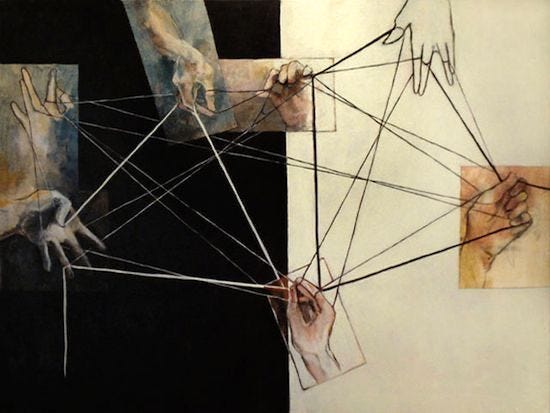
At the same time, these moments with friends cast a gently important light across my days. Rather than a side note to my life, messages with friends are its very fabric, the notes, half-thoughts, and jokes that stitch the passing days together. They keep the invisible thread between us intact even as our independent lives carry on and everything else changes.
Keeping in touch makes my world feel both smaller and wider at once. Each friendship hums like a pulsing light in the wide night sky. While I sleep, some are awake, moving through their days. Through their stories, I feel my life extend past its own limits, linked to worlds unfolding elsewhere.
Over time, this ‘work’ of friendship becomes the hidden infrastructure of a life. It holds so much in place: the continuity of who we’ve been, the scaffolding that lets us grow into who we’re becoming. When we tend to it, it’s always there, buffering against loneliness, reminding us that we exist in more than our own minds.
I’d love to hear - how do you stay close to the people you love?
If you enjoyed this piece and would like to support my work, you can do so through Buy Me a Coffee, either as a one-off or recurring contribution. Reader support is deeply appreciated, as it gives me the time and space to keep writing, and to keep it free for everyone to read.
Other forms of support mean just as much: subscribing, pledging, leaving a comment, restacking, or sharing a piece that resonated with a friend. Every small signal helps the words travel a little further through the noise.
This piece sits within a constellation of essays on attention and love. You can read the earlier ones here:
attention is love

Love is the difficult realisation that something other than oneself is real. -Iris Murdoch
how does love stay alive?

“Love doesn’t just sit there, like a stone, it has to be made, like bread; remade all the time, made new.”
im gonna stay in touch with my pals so hard after reading this
I stay in touch with people who make a similar amount of effort to stay in touch with me. This allows me to be more intentional and not spread myself too thin across too many people. I want meaningful, close relationships, and I know that won't be with everyone. So, those I choose to have depth with enough to call a friend, I will do the work of keeping in touch with them.